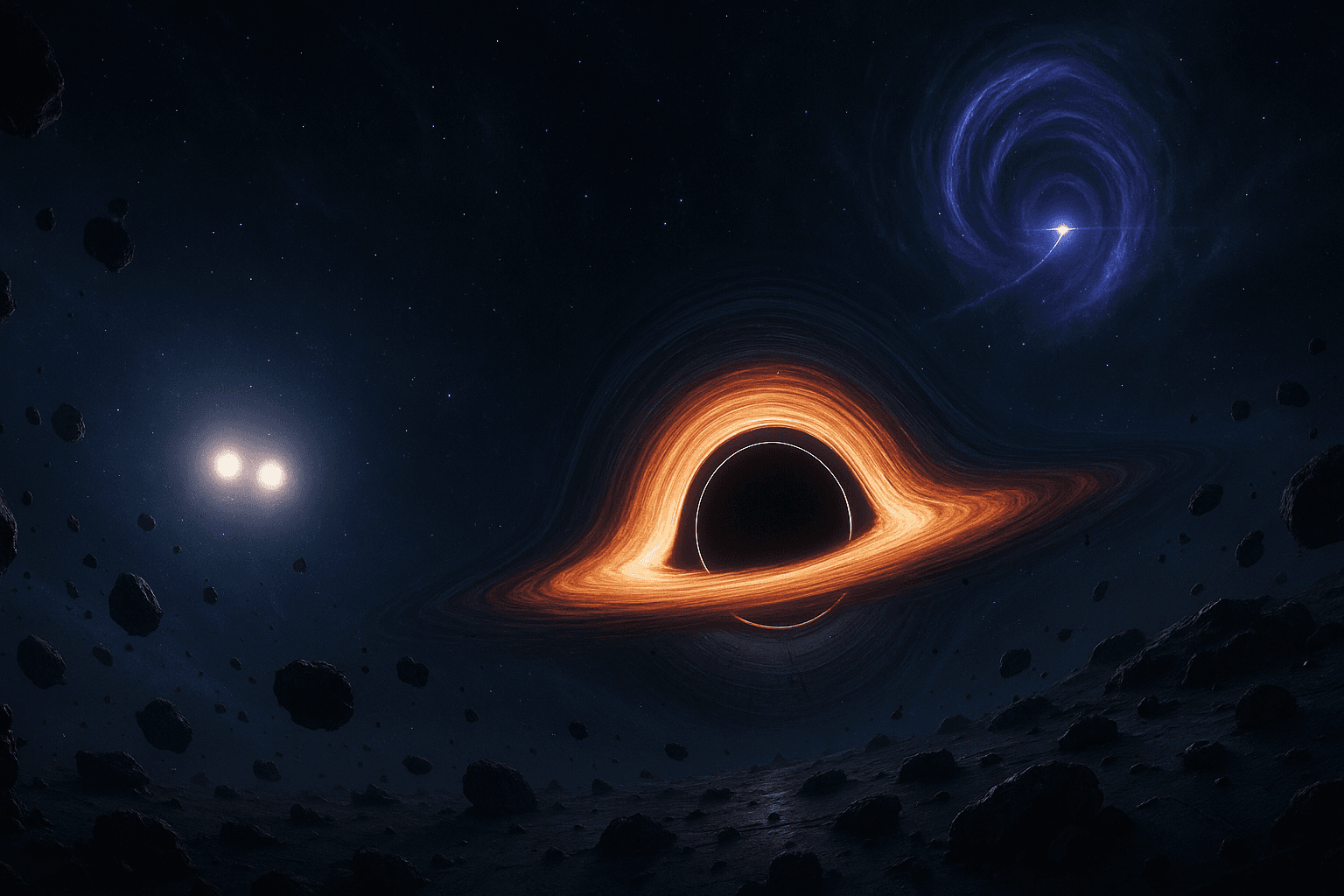
Stellar Phenomena
Not all stars are equal. Some systems harbor extraordinary celestial objects that reshape both the visual landscape and strategic calculus. These phenomena are generated during galaxy creation and remain permanent fixtures of the map.
Phenomenon Types
Black Holes
Spawn rate: ~2% of hostile systems
Black holes replace the normal star with a dark core surrounded by a rotating accretion disk. The star's glow layers are suppressed, replaced by a deep purple-black core with hot orange accretion emissions.
Visual: Dark core with rotating orange accretion disk in additive blend mode.
Pulsars
Spawn rate: ~3% of O/B spectral type stars
Pulsars emit rotating beams of energy that sweep across the system like a lighthouse. The normal godray effect is replaced by two opposed beam sprites rotating at a fixed period with brightness pulsing.
Visual: Two rotating ice-blue beams with periodic brightness variation.
Wormholes
Spawn rate: 2-4 paired systems per galaxy (assigned in post-processing)
Wormholes connect two distant systems with a swirling portal effect. A dashed connection line links the paired systems, visible at sector zoom and above. Each wormhole displays a rotating spiral glow in violet.
Visual: Violet spiral glow at each endpoint, dashed connection line between paired systems.
Asteroid Belts
Spawn rate: ~8% of any system type
Systems with asteroid belts display a ring of small rock particles orbiting the star. The particles drift at a configurable speed, creating a subtle orbital animation.
Visual: Ring of 24 small particles orbiting the system at varying distances.
Binary Stars
Spawn rate: ~5% of F/G/K spectral type stars
Binary star systems feature two stars orbiting a common center of mass. The primary star is rendered slightly smaller than normal, while the secondary star (at 70% scale) orbits at a fixed separation distance.
Visual: Secondary star sprite orbiting the primary on an 8-second period.
Discovery
Stellar phenomena are only visible for discovered systems. Undiscovered systems with phenomena appear as normal fog-of-war blips until a scout or sensor range reveals them.
Identification
Hovering over a system with a phenomenon displays its type in the tooltip. The System Panel also shows phenomenon information when a system is selected.
System Restrictions
| Phenomenon | System Type | Spectral Type | Max per System |
|---|---|---|---|
| Black Hole | Hostile only | Any | 1 |
| Pulsar | Any | O or B only | 1 |
| Wormhole | Any | Any | 1 |
| Asteroid Belt | Any | Any | 1 |
| Binary Star | Any | F, G, or K only | 1 |
A system can have at most one phenomenon. Phenomena and anomalies are independent and can coexist on the same system.
Gameplay Effects
Each phenomenon type carries gameplay modifiers that scale with the phenomenon's intensity value. Higher intensity means a stronger effect.
| Phenomenon | Effect | Scaling |
|---|---|---|
| Black Hole | Reduces fleet travel speed through the system | Speed penalty scales with intensity |
| Pulsar | Boosts research output for planets in the system | Research bonus scales with intensity |
| Asteroid Belt | Increases mineral (metal) production | Production bonus scales with intensity |
| Binary Star | Enhances energy production | Energy bonus scales with intensity |
| Nebula | Grants a defensive combat bonus to defenders | Defense bonus scales with intensity |
Strategic Implications
Phenomenon effects make system selection a deeper decision:
- Research hubs benefit from pulsar systems where lab output is amplified.
- Mining colonies thrive in asteroid belt systems with boosted mineral yields.
- Fortress worlds gain a natural advantage in nebula systems where defenders receive combat bonuses.
- Transit routes should avoid black hole systems unless the travel speed penalty is acceptable.
- Energy-hungry builds such as those powering shield generators or sensor arrays benefit from binary star systems.
Intensity varies between phenomena of the same type, so scouting systems before colonizing is important. A high-intensity pulsar system is significantly more valuable for research than a low-intensity one.